Careytown
Friends celebrate Kristi's, right foreground, and Sheryl's, on her right, birthday at Baker's Crust on Carey Street. Gayton
Two buddies — Shannon, left, and Liam, right — play in the nursery at Cambridge church. They love each other.A daily log of photography—moments found amidst each day
Toya enlists other customers eating lunch at Brenda's City Cafe in helping her select a new Spring hat.
Erich Bridges talks about the seminars he attended and the grand prize he received for feature writing at the professional meeting he attended last week. Three of his colleagues also won major awards in other disciplines, as well as others who received a fistful of firsts, seconds and honorable mentions for their work.
Sophie Harver with her father Craig leaving Cambridge church after Sunday services.
This denizen of one of the ponds on the grounds is the largest Eastern Painted Turtle I have ever seen. His carapace is larger than a turkey platter.
Tulips backlit in a window of Bloemendaal House. The house was at the center of a working farm until the botanical gardens took it over in 1968. Lewis Ginter built the house, but never lived in it. His niece, Grace Arents willed the property to the city of Richmond for a botanical garden with one caveat. Arents was a teacher who did much for the city, including starting a lending library. She died in 1926, but the caveat allowed a fellow teacher to live in the house the remainder of her life. The woman lived to be 102.
Jim Wendell of Virginia Beach, Va., demonstrates a High Wheel bicycle in front of Bloemendaal House. A fad in the the late 19th century, their popularity lasted only 12 years. The bikes cost the equivalent of $1,000 in 21st century dollars. When the less expensive modern safety bike was introduced, the High Wheels were eclipsed. Owners formed High Wheel clubs interested in a smooth ride and encouraged the beginning of modern pavement on city streets.
A painter framed—Paul Steinberg replaces one of his paintings before the concert scheduled for this evening at the Daily Grind.
Sadie trolls for people coming into the Grind while Sam and Dianne talk over breakfast. Sadie is certain everyone passing by wants to meet her.
Brad Yoder, a singer/songwriter from Pittsburgh, Pa., was the featured performer for the outdoor concert this evening. He is a wandering folksinger traveling thousands of miles a year for concerts in coffee houses, colleges and universities, churches and other venues. He is a favorite with the regulars at the Grind and performs here two or three times a year.
Ivy and Eric, center rear, stop at the Grind to hear at least one song by Brad before attending their prom. Scott Lashinsky accompanied him on the mandolin for several songs.
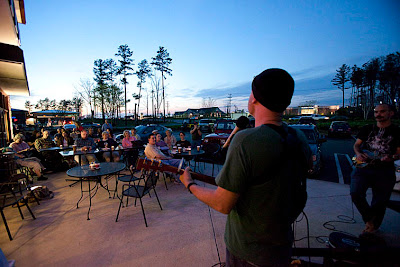
Sarah distributes candles to the tables as the sun goes down.
Scott, left, and Brad, right, end the concert well after dark with an audience participation number.
Shamus, foreground, and Andy, seated, wait with their humans, Janice and Walt McCally, for their car to be serviced at Pence Pontiac-Jeep. Shamus is one year old, Andy 13.
October Rain played to a standing room only crowd at the Daily Grind this evening. The band is composed of, left to right, Eric Fulcher, Mike Beaudoin, Melissa Beaudoin and Andy Rush. They played a selection of their compositions and covers.
Eric plays "Knock on Wood" by Justin King. The fret work, picking and percussion on the soundboard reminded me of the Flamenco of Segovia and Montoya.
Each evening when we return home, the throw on our sofa is bunched and the pillows scattered. We knew it was the dogs, but weren't sure how it got that way. This morning they forgot I was home. Now we know.
Front yard squirrel samples the latest offering on our window bird feeder — obviously oblivious to how close I am — and that she is stealing from the birds.
Kathryn honors the Easter Bunny while serving up coffee and breakfast at Boychik's Deli. The deli is consistently voted as having the "Best Breakfast in Richmond."
Good friends Bill, above, and Nancy, below, Lively from Annapolis spent two nights and day with us, We have known them for 40 years.
National Park ranger Nathan Bullard demonstrates the maneuvers of Grant and Lee during the Cold Harbor campaign at the end of the American Civil War. More Americans were killed, wounded or captured during this campaign than were lost 80 years later during the Normandy invasion of World War II.
Some of the best preserved trenches from the American Civil War are preserved at Cold Harbor. Union troops attacked from exposed positions trying to take this Confederate position. The battle and the use of trenches set the stage for the practice of warfare over the next 50 years.